Harney had been assigned as a temporary commander for several months on an expedition in the upper Midwest. During that campaign, he got into an argument with his commanding officer, Maj. Stephen Kearney, that was so vociferous that he was arrested. In a court-martial for "Mutinous and Insubordinate Conduct," he was found guilty after a three-day trial and issued an official reprimand.
September 3, 1855 · Ash Hollow, Nebraska
The Blue Water Creek Massacre
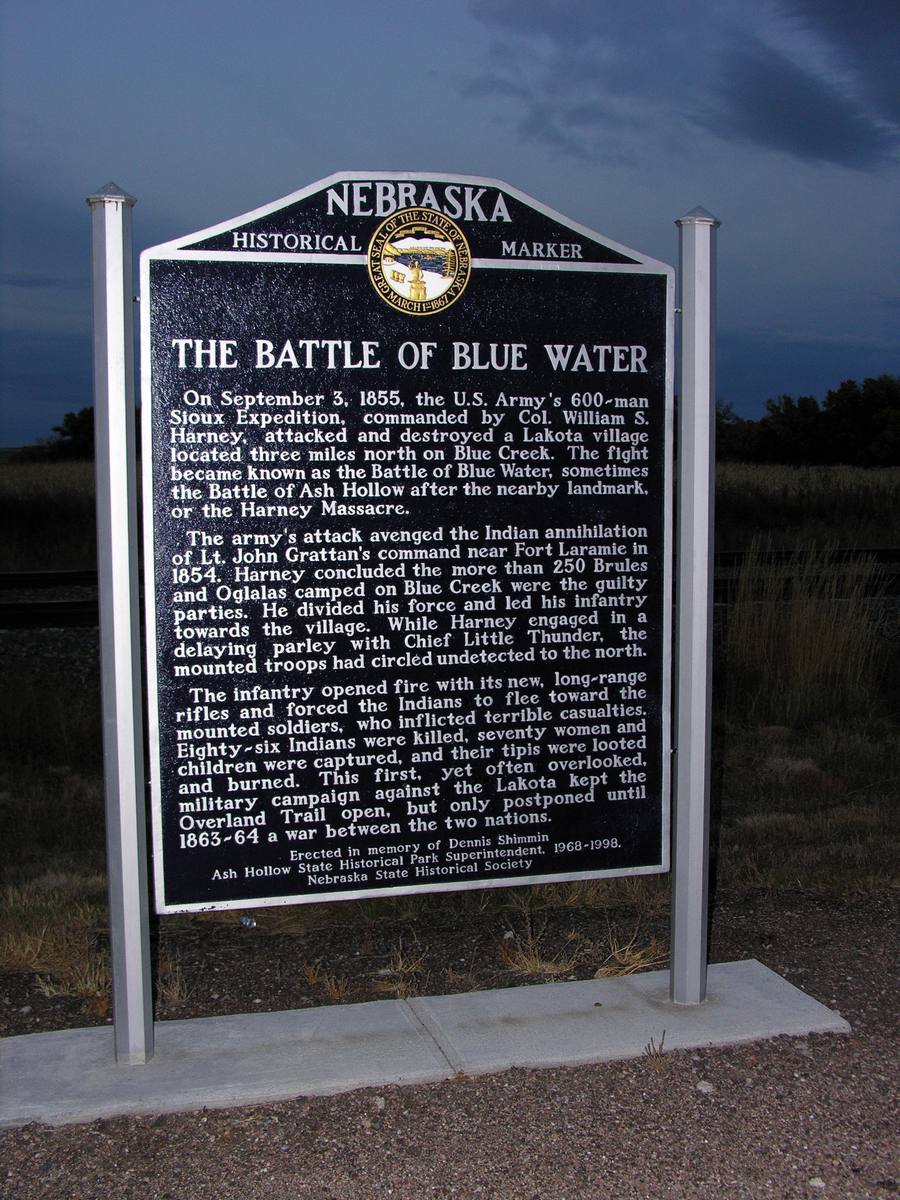
On September 3, 1855, troops under Gen. William S. Harney attacked Little Thunder's Brulé Sioux village on the Blue Water near Ash Hollow, Nebraska. Harney counted 86 killed; other witnesses put the dead at 100 to more than 200, many of them women and children.
Although the exact toll is uncertain, there is no dispute that the attack was one of the most brutal massacres in the history of the United States.
Background: an expedition for punishment
The expedition was organized to punish the Sioux for two earlier killings: the deaths of Lt. John Grattan and his party in August 1854, and the attack on the Great Salt Lake mail party that November.
Secretary of War Jefferson Davis, who would later become president of the Confederate States, summoned Harney home from leave in Paris and gave him command at his brevet rank of brigadier general. His orders were to operate against the hostile Sioux and protect the emigrant routes. He was also told that whenever he found an opportunity "to strike a blow with the prospect of a decided result," he need not feel restrained by the strict letter of his instructions.
The force numbered about 600 men, drawn from the 2nd Dragoons (Harney's own regiment), the 6th and 10th Infantry, and the 4th Artillery. The historian Robert Utley notes that Harney had concluded from the Black Hawk and Seminole Wars that Indians should be whipped soundly before any peace talk was allowed.
"By God, I'm for battle – no peace."Harney to the trapper Edward Morin, leaving Fort Kearney
Intent
Harney made clear before the march that he wanted a fight, not a settlement. Morin later reported that the general was planning the extermination of all the Sioux he could find.
On the evening before the battle, Harney spotted the village through his glass and addressed his troops. He called the Sioux "damned red sons of bitches" who had massacred soldiers near Laramie in peacetime and killed the men's own kindred. He told his men they deserved damnation if they failed, and ordered: "Don't spare one of the damned red sons of bitches."
The parley: a white flag used as a stall
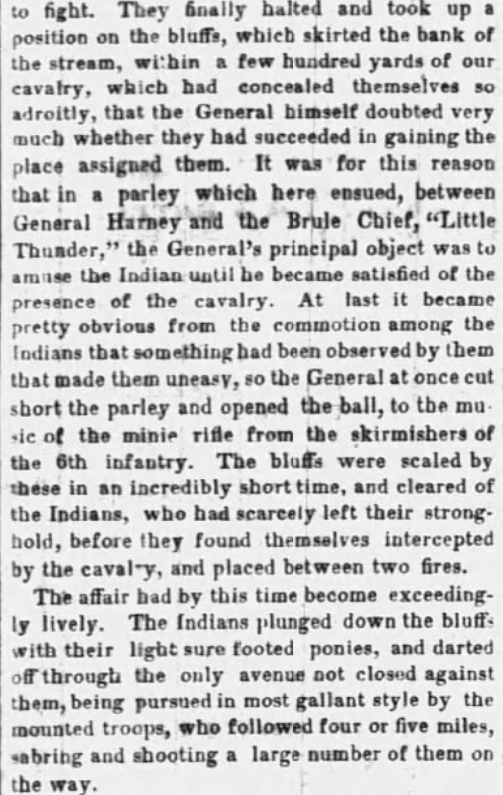
The Brulés tried repeatedly to talk, and Harney used the talk to buy time for his trap. Before dawn on September 3, the cavalry under Lt. Col. Cooke forded the North Platte around 2 or 3 a.m. They circled behind the village and lay hidden in tall grass for over two hours. The infantry advanced from the front at about 4 a.m.
As the troops approached, a party of eight or ten Sioux on the hills made signals. Captain John B. S. Todd wrote that these were disregarded. A letter in the Daily Missouri Republican was blunter: the Indians showed signs of wanting to parley, but "as we had come for war and not for peace, we paid no attention to them." Harney first refused to receive a delegation, and the infantry kept advancing.
Little Thunder then came forward under a white flag. Todd's journal records what followed:
- The talk lasted 30 minutes to nearly an hour, with Harney standing 30 or 40 feet from the chief.
- Harney used the talk as an opportunity to stall while his soldiers surrounded the village.
- Little Thunder said he was friendly, could not control his young men and did not want to fight.
- He offered to shake hands. Harney refused, saying he could not take the hand of a man he expected to fight in a few minutes.
- Harney demanded that the chief hand over the young men responsible for the Grattan and mail-party killings. In his own report, he admitted the chief was not able to do this "however willing he might have been."
- Harney told him "the day of retribution had come" and to get out of the way if he did not want to be hurt.
The emigrant William Chandless concluded that Harney made his terms so harsh that they were sure to be rejected. A correspondent of the St. Louis Democrat stated outright that the parley's main purpose was to "amuse the Indians" until Harney was sure his cavalry was in position. As soon as Little Thunder rejoined his people, Harney gave the order to advance and then to open fire.
The attack and pursuit
The attack was designed so the Sioux had nowhere to go. Todd's Company A opened fire with long-range rifles from a distance the Indians did not think their guns could reach. Their arrows and old flintlocks could not reach the troops. The Sioux at first took the fire calmly, then fled toward the hills, whipping and spurring their horses.
The gunfire was the signal for the hidden dragoons, who appeared directly in front of the fleeing Sioux. Harney's own report calls this a "snare." The Indians turned toward the only opening left, a ravine. Todd's men fired down on them from high ground, "knocking them out of their saddles, right and left." As people fell, others jumped from their horses to carry them away. Todd's company sent up three cheers as the cavalry charged.
The dragoons then chased the survivors for five or six miles over rough country, in what Todd called "a perfect melee." Harney's report describes the cavalry killing a large number and completely dispersing the band. The infantry, he wrote, were eager for a fight with "the butchers" of Grattan's men.
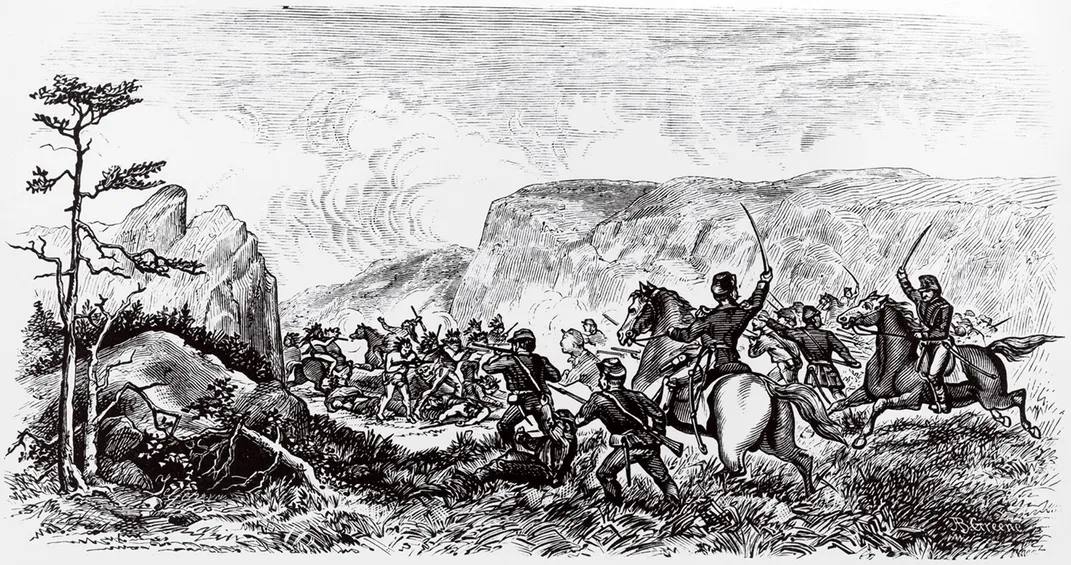
Some soldiers wrote about the slaughter with obvious enjoyment. One letter in the Daily Missouri Republican said that when the dragoons appeared, "the fun commenced in reality. I never saw a more beautiful thing in my life." The same writer bragged that the band had never had "such a perfect clearing out" and would "remember Gen. Harney for a long time." Chief Bugler John M. Sullivan of the 2nd Dragoons wrote that they made the Sioux "bite the dust in dozens."
Lt. Gouverneur K. Warren, a topographical engineer on the expedition, saw it differently. He was disgusted by the tales of valor told afterward, noting that few soldiers "killed anything but a flying foe." Wounded Sioux men who were cornered fought desperately; Warren wrote that all who stopped were killed, some reportedly with the sword.
The killing of women and children
Women and children were killed and maimed in large numbers, and soldiers on the scene said so plainly. One letter writer stated, "We, of necessity, killed a good many women and children." Warren's private journal shows that the army massacred large numbers of noncombatants at Ash Hollow.
Many families hid in holes among the rocks, where armed men also took shelter, and the troops fired into the holes. At one spot, two Indian men and three children died, two of the children in their mothers' arms. Warren's published report counts five men, seven women and three children killed near one hole.
Warren described the hilltop afterward as heart-rending, with wounded women and children crying and moaning, "horribly mangled by the bullets." He recorded individual victims as he carried them down to the Blue Water:
- A young woman shot through the left shoulder, whom he put on his horse.
- A woman shot above the left knee by a bullet that also struck her baby's right knee. Her father had been killed. She cried continuously, turning to her baby and singing words Warren understood as "O God, my poor child." The baby died the next morning, and the mother did nothing but cry and moan.
- A girl of about 12, lying head-down in a ravine and nearly dead, shot through both feet.
- A little boy shot through both calves and his hams, who clung to Warren's neck as he was carried.
- A girl shot in the right breast, a boy in the thigh and another boy in the arm.
- An Oglala woman shot badly in the shoulder by a dragoon after the fighting was over. He found her hiding in the grass and said he took her for a man.
A week later, soldiers found two children, the elder about 12 and wounded in the shoulder, who had eaten nothing but roots since the attack. Eugene Bandel of the 6th Infantry believed scarcely ten of those who escaped were unwounded.
Death toll
Harney officially counted 86 dead; other estimates range from about 70 to more than 200. Several writers explained that the Sioux carried off many of their dead and wounded, and bodies were scattered over miles. Warren passed one body several times without seeing it until ravens drew his attention four days later.
| Source | Sioux killed | Captured |
|---|---|---|
| Harney's official report | 86, plus an indefinite number killed and disabled | About 70 women and children |
| Capt. Todd's journal | 86 known | 60 women and children, no warriors |
| Daily Missouri Republican letter | About 70 | — |
| Bugler John M. Sullivan | About 100 | 50 |
| Eugene Bandel | Perhaps 120 of over 300 | About 40 |
| William Chandless | About 150 | 60 |
| Shepherdstown Register | 90 counted; at least 160 estimated; some said over 200 | 38 women plus children |
| J. R. Adams (Burlington Weekly Sentinel) | 200 | — |
Army losses were light by comparison: Chandless put them at seven or eight, and Warren recorded five mortal wounds among the soldiers.
Aftermath: bodies, plunder and starvation
The troops left the Sioux dead unburied and destroyed the band's means of surviving the winter. Bandel wrote that the soldiers took their own dead with them and left the Indians' bodies to the wolves. Days later, Chandless's messmate Landon found wolves and ravens still feeding, with most bodies already picked clean. The emigrant J. R. Adams and his sons saw the dead rotting in the sun where they fell.
The flight route was littered with bloody saddles, clothing and bodies the Sioux could not carry. Two Indians who escaped were later found dead of their wounds on the banks of the Platte, their ponies grazing nearby.
The soldiers seized or burned nearly everything the band owned:
- More than 3,000 pounds of dried buffalo meat
- Buffalo robes and hides, and all the lodges except three kept for prisoners
- About 40 to 50 ponies and mules
- Saddles, powder horns and camp equipment
Sullivan boasted that the men now had fancy Indian war dresses and ponies, and the Shepherdstown Register writer said they had so much plunder they could not move. Chandless noted that because the attack came so late in the season, the loss of food was expected to starve many more Sioux that winter.
The captured women and children were taken to Fort Kearny. Utley notes that fear of what might happen to them became leverage over the Sioux in the months that followed. Harney's troops built an earthwork at Ash Hollow and named it Fort Grattan.
A campaign of intimidation
After Blue Water, Harney used fear to force the Sioux into submission. He marched into the heart of Sioux country north of the Platte, challenging the bands that had refused his order to move south of the river. They avoided him.
He spoke curtly to the bands that had already declared for peace, telling them nothing would be discussed until the mail-party killers were surrendered. With chiefs, he deliberately took a severe manner. His terms were the surrender of the killers, the return of all stolen animals and a promise to keep the road open. By his own account, the chiefs "begged piteously to be spared" and asked only to be allowed to live. In November he wrote that they described themselves as in a pitiable condition, suffering for everything and wanting only to live.
Utley lists the pressures that broke the Tetons' resistance:
- The catastrophe at Blue Water
- Fear for the women and children held prisoner at Fort Kearny
- The invasion of their ranges north of the Platte
- Harney's suspension of the Indian trade
On October 25, the men responsible for the mail-coach killings rode into Fort Laramie and surrendered. In a November 9 circular to the Sioux chiefs, Harney summoned ten trusted men from each tribe to a council on March 1, 1856, warning, "All those who wish the war to continue must not come." The chiefs made a hard winter journey to Fort Pierre to obey.
Harney drafted the resulting treaty himself, intruding on the Indian Bureau's authority. Commissioner of Indian Affairs George Manypenny, already upset by the Blue Water attack, worked with Thomas Twiss, the U.S. Indian agent for the Upper Platte, to block it, and the Senate rejected the treaty.
Reaction and legacy
The attack drew some criticism at the time and left a lasting hatred among the Sioux. The New York Daily Times published a piece asking whether extermination was just, humane or right, and whether there was no way to end the conflict except by wiping out the weaker race.
The Sioux gave Harney several names. The Burlington Weekly Sentinel reported that they called him "the Mad Bear." According to Utley, the Teton Sioux never forgave him and named him:
The Mad Bearfor his intense aggression, relentlessness and volatile temperament
The Woman Killerfor his unrestrained atttack at Blue Water
The Butcheralso for his merciliess atttack at Blue Water
The Hornetfor the invasion of their stronghold
The Big Chief Who Swearsfor the councils at Laramie and Pierre
Utley's judgment is that Harney, untroubled by considerations of justice and humanity, cowed the Sioux as no later commander would.
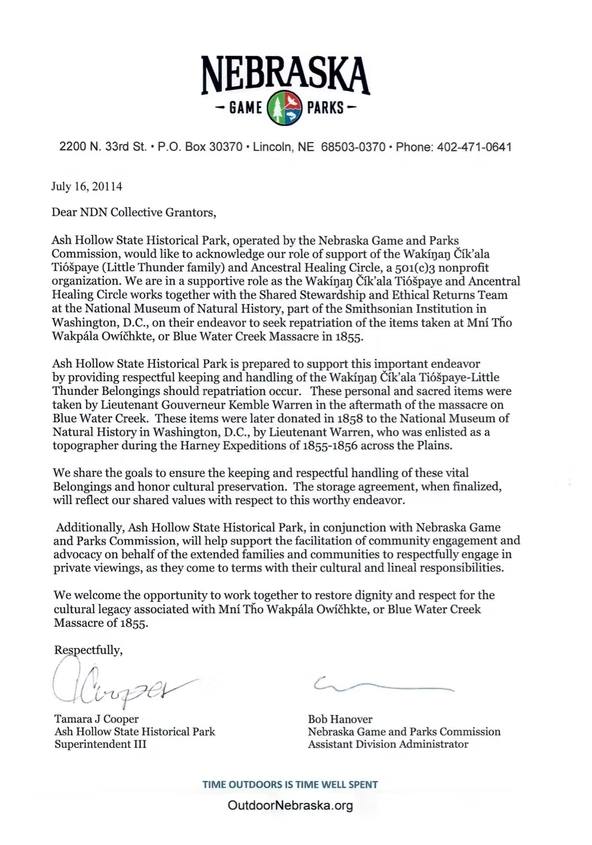
In 2025, on the 170th anniversary of the massacre, 69 sacred belongings were returned to the Wakíŋyaŋ Čík'ala and Sičháŋǧu Tióšpaye communities. Known as the Warren Collection, or simply "Belongings," the items were returned to the people from whom they were taken through a partnership with the Smithsonian Institution's NMNH Ethical Returns and Shared Stewardship Program.
1834 · St. Louis, Missouri
The Death of Hannah
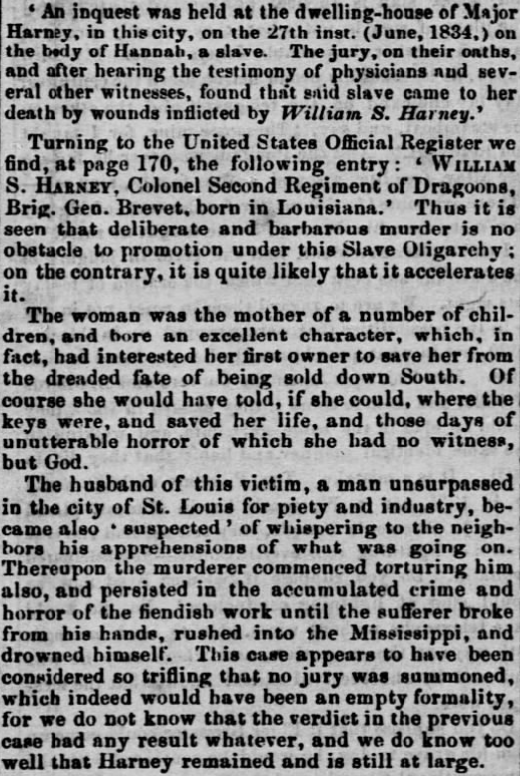
In 1834, St. Louis was the scene of a widely publicized slave beating. The perpetrator was William S. Harney, then a major in the U.S. Army stationed at Jefferson Barracks.
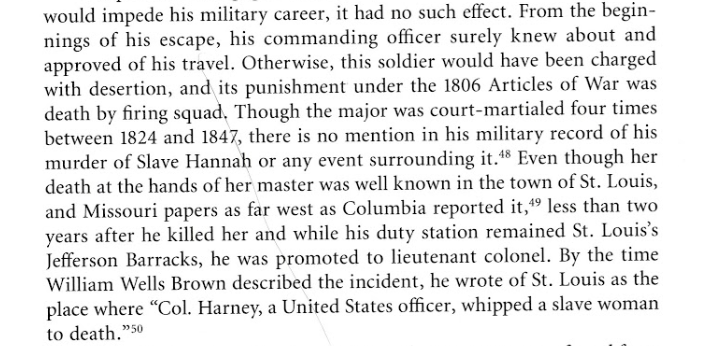
In October 1833, he had married Mary Mullanphy, a daughter of the late St. Louis merchant John Mullanphy, who brought a large dowry to the marriage. About eight months later, at the couple's St. Louis home, Harney beat his enslaved woman, Hannah, over three successive days. He believed she had hidden some misplaced keys and thought a severe enough whipping would make her reveal where they were. She never did, and she died. After examining her body and hearing from several physicians and other witnesses, a coroner's jury concluded on June 28, 1834, that Hannah had died of wounds Harney inflicted.
Under the 1806 Articles of War, a commanding officer had to hand over a soldier accused of a capital crime to civil authorities on request. Surviving letters and a diary suggest that Harney's commanding officer turned the case over to the St. Louis County prosecutor.
Flight
In early July 1834, when it became known that Harney had killed Hannah, an angry mob tried to drive him out of hiding at the home of Ann Biddle, the widow of a fellow officer. By then Harney had already left town, with the knowledge of his wife's family, including her brother Bryan Mullanphy, an attorney and later mayor of St. Louis.
Four letters sent to Harney between July 4 and August 13 trace his flight. He most likely went by steamboat down the Mississippi and up the Ohio to Wheeling, Virginia, then east along the National Road. He spent time in Wheeling, Baltimore and Washington, D.C., all places where slavery was legal at the time.
The letters warned him that a mob had nearly torn down the Biddle house and that a grand jury was expected to indict him. They advised him not to return for perhaps two or three years. His brother-in-law James Clemens Jr. later told him that an indictment for murder had been returned, warned that Missouri's governor might demand his extradition, and arranged a bond with the Mullanphy heirs as sureties. The letters refer to the killing only in euphemisms, such as calling it an "affair." In one, Clemens remarked casually that similar incidents had occurred locally without any notice from the public or the courts. Harney's replies do not survive.
Acquittal
Newspapers condemned the crime. The Cincinnati Journal published an indignant account, later reprinted in William Lloyd Garrison's Liberator, that called Harney a monster and urged the army to cut ties with him.
Because of public hostility toward him in St. Louis, Harney was granted a transfer away from the city. Facing a murder indictment there, he secured a change of venue to the circuit court of Judge Lawless, a renowned pro-slavery politician, who acquitted him. A St. Louis diarist recorded the acquittal in March 1835. Like other Missouri men known to have killed enslaved women, Harney went unpunished.
1837 – 1842 · Florida
The Second Seminole War
In 1837, Harney was given command in the Second Seminole War, a campaign to expel Indigenous people from their Florida homelands. His personal temperament (vengeful, impulsive and brutal) would make his Florida service one of the most violent chapters of the entire conflict.
The Macomb Treaty and the Caloosahatchee Ambush, July 23, 1839
Harney's vendetta against the Indigenous people of the southeastern woodlands, including the Seminoles and the Miccosukee, began with a humiliating military disaster that was, in significant part, his own fault.
In 1839, a peace agreement called the Macomb Treaty had been negotiated, theoretically ending the war by allowing the Seminoles to remain in southern Florida. As part of the peace arrangement, a trading post was built. Harney traveled to Sanibel Island to hunt for wild hogs, and during his absence, the man left in charge neglected his duty to post guards around the camp and hand out ammunition.
A catastrophe followed. Most of the soldiers and all of the trading post's civilian employees were killed. Harney, who was wearing only his underwear, escaped by jumping out of bed and diving into the Caloosahatchee River. Embarrassed by the Indians' one-sided victory, he spent the next eighteen months obsessively hunting them.
"There must be no more talking—they must be hunted down as so many wild beasts, and we must employ every means that may assist us in taking or destroying them. Let a liberal reward be offered for every Indian taken, dead or alive, and let every one taken be hung up in the woods to inspire terror in the rest."Harney to Col. Zachary Taylor
In the same letter, Harney wrote, "There can now be no doubt of our … change in our policy toward them."
Harney's revenge operation stands as one of the best-documented episodes of extrajudicial violence in Seminole War history. Its methods (disguise, ambush and hanging without trial) went beyond conventional warfare, even by the brutal standards of the era.
Into the Everglades, December 1840
In December 1840, Col. Harney finally got his revenge when he led ninety men into the Everglades. He pursued the Native Americans, capturing some of them and promptly hanging the men. It was recorded that Harney watched from a treetop and cheered his approval as his soldiers hanged the captured men while their wives and children were forced to watch them die.
One officer described how Harney "caused twelve Indians to be executed and left hanging, ghastly pendants to the moss-covered pines." He brought back the captured women and children, "striking consternation to the hearts of the savages, who had hitherto believed themselves safe from molestation" in the Everglades. Harney also tried to force the captured Seminole women to lead the way to their camp, reportedly by threatening to hang their children.
Harney's group found the camp, and as the unarmed leader Chakaika was attempting to surrender, he was shot. Harney then "sadistically strung Chakaika's body up" in a tree alongside two fellow Seminoles as a display for Chakaika's wife, children and friends.
To this day, traditional Miccosukee do not set foot on the island where the hangings took place, south of the Tamiami Trail in Everglades National Park. They remember it as Hanging Island.
Return to the Everglades, 1856–1857
Harney's violence in Florida did not end with the Second Seminole War. After the Third Seminole War broke out in 1855, he was sent back. In 1856 and 1857, he ordered his troops to comb the Everglades for any sign of human habitation and systematically destroy the Seminoles' homes. This was scorched-earth warfare aimed at civilians (their food, their shelter and their means of survival) rather than at combatants.
September 1847 · Mexico City
The Hanging of the San Patricios
In September 1847, Harney served as executioner of the Saint Patrick's Battalion in what was the largest mass execution in U.S. military history. He staged the final hanging, on September 13, to coincide with the U.S. flag rising over Chapultepec Castle.
The Saint Patrick's Battalion, or San Patricios, was a Mexican Army unit that fought against the United States in the Mexican-American War. It was made up of several hundred mostly Irish and other Catholic European immigrants. During the 1840s, the U.S. Army began recruiting Irish immigrants who were arriving at American ports by the tens of thousands, desperate to survive after the Great Potato Famine.
Many of the Irishmen serving in the army faced racism and anti-Catholic prejudice, and the harsh and cruel treatment that resulted drove many to desert or defect. Others in the battalion were escaped slaves and free Black men who saw Mexico, which had outlawed slavery, as a freer country than the United States and who fought against the expansion of slavery. Mexico offered them higher pay, land, citizenship and, most importantly, religious freedom if they switched sides. These disenfranchised men faced a moral dilemma: a military that treated them as second-class citizens had sent them to conquer a Catholic nation.
Trials and sentences
Many members of the battalion had left the U.S. Army before war was officially declared, so U.S. military law spared them from execution. Instead, they were lashed and branded on the cheek with a "D" for deserter. For 50 others, who deserted after the declaration of war, the penalty was death.
Two mass trials were held, three and six days after the men's capture. The accused were denied legal counsel, and no transcript was made of the proceedings. The San Patricios were found guilty and hanged in three separate executions, with Harney in charge of the later ones.
Chapultepec: the hanging Harney staged
Harney personally designed the final execution as a theatrical spectacle timed to the fall of Chapultepec Castle. He ordered the 30 men hanged with the castle in view. They were to die at the moment the U.S. flag replaced the Mexican tricolor over the citadel.
At dawn on September 13, 1847, Harney had the prisoners brought forward. They were bound hand and foot and stood on wagons with nooses around their necks, within sight of the coming battle. They stood that way for nearly four and a half hours in the hot sun. At 9:30 a.m., when the American flag rose over Chapultepec, Harney gave the order. The wagons were pulled away, and all 30 men were hanged.
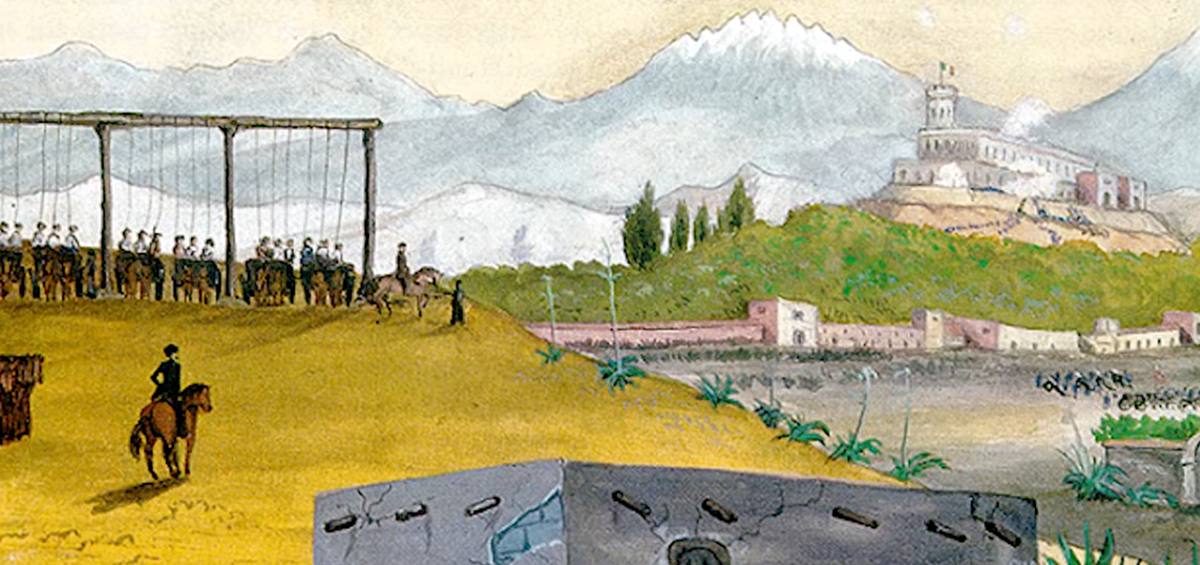
The most notorious moment of the executions involved a prisoner named Francis O'Connor. Harney counted only 29 of the 30 condemned and demanded to know where the last man was. The army surgeon told him the missing prisoner had lost both legs in battle.
"Bring the damned son of a bitch out! My order was to hang 30 and by God I'll do it!"Harney, on learning O'Connor had lost both legs
Guards dragged O'Connor out and propped him up on his bloody stumps. He was hanged with the others.
Harney's cruelty continued after the men were dead. He refused to take the bodies down, saying, "I was ordered to have them hanged and have no orders to unhang them." The corpses of the 30 men were left to decay on the gallows as a warning to residents of Mexico City who might resist American forces.
Historians have argued that the hangings themselves broke military law. Under the Articles of War, the penalty for desertion or defecting to the enemy in wartime was death by firing squad. Hanging was reserved for spies out of uniform and for atrocities against civilians. The San Patricios were hanged anyway.
The violent display deepened Mexican resentment of the American occupation and spurred guerrilla forces to fight back against the Americans.
The men Harney hanged are now honored as national heroes in both Mexico and Ireland.
1859 – 1860 · San Juan Island
The Pig War
On June 15, 1859, an American settler shot a pig belonging to the Hudson's Bay Company after finding it in his garden on San Juan Island, which lies between Canada's Vancouver Island and the Washington Territory.
The United States and England both claimed the island because an 1846 treaty had left it unclear which channel marked the boundary.
British authorities threatened to arrest the settler and evict all Americans from the island as trespassers. In response, Harney ordered Captain George Pickett and an infantry company to occupy the island. The British sent warships, and Harney reinforced the American garrison. A dispute over a pig had escalated into an armed standoff between two contentious nations.
Defying the settlement
President James Buchanan sent General Winfield Scott to defuse the crisis. Scott and British Governor James Douglas agreed to reduce their forces, and the two countries eventually established a joint military occupation while leaving the boundary dispute unresolved.
Scott replaced Pickett with Captain Lewis C. Hunt, but on April 10, 1860, Harney reversed that decision. He sent Pickett back and instructed him to recognize Washington Territory's civil authority on the island. Scott warned the War Department that avoiding another armed confrontation would depend on British restraint. The United States and England had been brought to the brink of war, and officials from both nations, unaware of the bizarre atmosphere on San Juan, were shocked by the escalating conflict and took action to calm the potential international incident.
Removed from command
On June 8, 1860, the War Department ordered Harney to turn over command of the Department of Oregon and report to Washington. Secretary of War John B. Floyd rebuked him for violating both Scott's order and the agreement with Britain, writing that his actions could have had "disastrous consequences." Harney was officially reprimanded and reassigned for allowing the situation to escalate needlessly. Although he avoided a court-martial, the incident cost him his command.
1824 – 1860
Courts-Martial
When a member of the armed forces is accused of violating military law or rules, they are judged for their offense in a military court. Harney was court-martialed four times while serving in the U.S. military and was found guilty each time.
On two other occasions, he avoided trial but was removed from his position because of his ineffectiveness.
A second court-martial followed when Harney repeatedly missed roll call and, for nine consecutive days, refused to take charge of his company at morning drill. His excuse was that he was too ill, as he had gonorrhea, diarrhea and a headache. He was again charged by Maj. Kearney, this time for "Unofficerlike & Ungentlemanlike Conduct." After a five-day trial, the tribunal found Harney not guilty of pretending to be sick but guilty of failing to perform his duties. He was sentenced to suspension from command for three months.
Harney earned a reputation for abusing and quarreling with fellow officers, and he had a documented clash with a captain after trading him a horse he knew to be stolen. The most prominent incident occurred when he violently thrashed two enlisted men. The pair had refused to dig a latrine, and an enraged Harney threw one of them to the ground and beat him with a cane. The resulting injury put the man in the infirmary for a week. Harney had the other man shackled with a ball and chain and fitted with a spiked collar, which he had to wear during 27 days of hard labor.
After a 10-day trial, Harney was found guilty of "arbitrary and unmilitary conduct detrimental to good order and military discipline." He was sentenced to another reprimand and suspended from rank and command for four months.
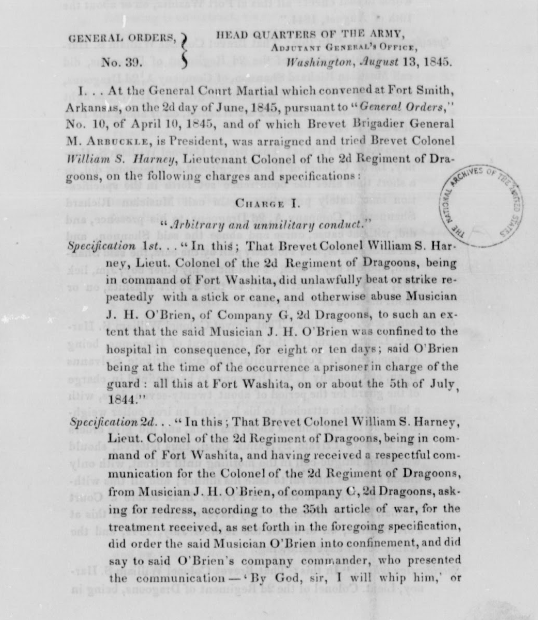
Eager for combat with Mexico, an overzealous Harney decided to cross the border and invade the Mexican interior. He proceeded without authorization, and the movement conflicted with the War Department's strategic plans. The venture also badly depleted much-needed supplies. After he returned, Harney was told to consider himself under arrest for abandoning his post without orders, leaving a large amount of public property unprotected and disobeying a general's orders. However, he was not officially arrested, as he had not received an order.
Harney had been judged unfit for command, yet he was still needed because the army was expanding for the wars with Mexico and Native Americans. He was ordered to turn his command over to his subordinate and report for an alternate assignment. Instead, Harney refused to leave, stating that no one short of the President could deprive him of command of the regiment. He was charged with disobedience of orders and insubordination. Harney was found guilty of disobeying orders, received another reprimand and was relieved of his command.
Harney nearly received a fifth court-martial when he ignored a general's order to stand down in a conflict over a colonial island's sovereignty. A potential conflict with Britain, which started over a pig, was narrowly avoided after Harney refused to de-escalate and instead sent reinforcements. Harney was removed from his command and ordered back to his home in St. Louis. He subsequently "became enmeshed in more petty quarrels and potential court-martials cases than any other time since the Mexican War."
Other Acts
Before his marriage and his years in St. Louis, Harney was stationed at Fort Winnebago. There, in 1828, he had a sexual relationship with Ke-sho-ko, a mixed-race Winnebago woman, and she bore him a daughter Mary Caroline Harney. The relationship formed under the deep imbalance of power between an Army officer and an Indigenous woman living near his post.
Historical documentation—including letters witnessed by contemporary frontier figures like Robert and Alexander Grignon and fur trader Hercules L. Dousman—later verified Caroline as the "reputed, known and acknowledged daughter" of Ke-Sho-Ko and Harney. When Harney received new military orders he abandoned both Ke-Sho-Ko and their infant daughter.
For generations, the connection between General Harney and the girl were treated as strong frontier oral history backed by local church archives. In recent years, modern DNA testing has officially confirmed a genetic link between the living descendants of Mary Caroline Harney and the descendants of General William Selby Harney's later marriage to Mary Mullanphy, proving the lineage beyond doubt.
In November 1848, Harney was a passenger aboard the steamship Alabama, returning from the war in Mexico. Among his fellow passengers was a wounded, discharged soldier named Lang. When Lang and others complained about the food on board, Harney beat him severely. Lang took him to civilian court. On January 18, 1850, the Boston Daily Evening Transcript reported that a jury had ruled against Harney for assault and battery and awarded Lang $700 plus costs. The man Harney attacked had served and been wounded in the same war that had just earned Harney a promotion to brigadier general.
Harney was himself an enslaver. Beyond Hannah, he owned a group of muscular enslaved men whom he provoked into fistfights with soldiers for his own entertainment. Historian Justine Meberg notes that he was reprimanded for pressuring a soldier to fight one of them.
His reputation followed him into the national fight over slavery. In 1856, when Harney was sent to Kansas, then torn by violence over whether it would become a slave state, the Cincinnati Commercial wrote sarcastically that he had "the reputation of being the most desperate and brutal officer in the service, and is, therefore, admirably fitted to sustain the law and order cause in Kansas." The paper reminded readers that "he once whipped one of his negro women to death" and predicted he would "slaughter Black Republican women and children as readily as redskins." It wondered whether he would set out "on his expedition against the Free State people" with the same cry he had used against the Sioux: "No peace, by God — I'm for battle." (Reprinted in the Saint Paul Weekly Minnesotian, June 14, 1856.) "Black Republican" was the period's slur for antislavery Republicans.
Those suspicions stayed with him. Historian Harriet C. Frazier writes that "because of his suspected southern sympathies, Harney held no important command during the Civil War."
: In 1861, Harney commanded the Army’s Department of the West in St. Louis. He made a truce with Sterling Price, who led Missouri’s pro-secession state militia. Missouri Unionists distrusted Harney, and President Lincoln removed him from command that spring.